Part of learning a new language is learning how to talk about math. Unfortunately, math has not traditionally been a regular part of adult ESOL instruction, and many ESOL teachers are not comfortable teaching it. This self-paced, online course and optional community of practice will encourage ESOL teachers to look for where, when, and how it makes sense to include math in lessons while continuing to focus on language acquisition and effective communication.
- ESOL instructors interested in integrating math into their language acquisition classroom. No prior math background is needed. The content is appropriate for all ESOL levels.
This professional development activity/course is designed for:
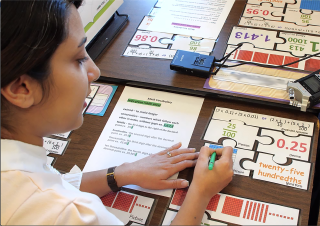
This six-hour, asynchronous course provides conceptual understanding of math topics around whole numbers, including cultural differences in procedures and notation. The course offers strategies and lesson ideas for making math accessible to all levels of ESOL students. During the course, you will engage with some math practice activities, watch videos of ESOL students working on math problems, view animations of math concepts, and learn about instructional strategies you might use in your own classroom.
You are also strongly encouraged to attend a 2-hour Community of Practice virtual meeting and/or individual coaching.
Schedule:
- Self-paced online modules open November 2 - December 4.
- The optional Community of Practice and/or individual coaching date/time will be arranged by the course facilitators with participants after the course begins.
Please note: Registrants will receive a separate email from sherry_soares@terc.edu from the SABES Math Team at TERC with instructions on how to access the course in Canvas.
Did you know? You can bundle this course with other ESOL-Math PD offerings to receive Professional Development Points (PDPs).
- Compare and contrast math notation in the United States and other countries
- Describe key elements of effective planning for math integration
- Articulate the different meanings of subtraction and division
- Perform basic operations using U.S. and European algorithms
- Scaffold the vocabulary needed for teaching related operations with whole numbers to ESOL learners
- Reflect on your own teaching vis-à-vis integrating math operations using whole numbers
Upon completion of this professional development activity/course, you will be able to:
United States